
Unveiling the mystery! A deep dive into the 3 depth levels of the Ulthera head: Why can't one use just one head for skin tightening?

Ever wondered why some people see amazing results after the Ultherapy Prime skin tightening program, with dramatically lifted and defined jawlines, while others feel the results aren't quite right? The secret isn't just in the "number of shots," but in the secret weapon called the "Ulthera head " (Transducer)!
Many people interested in this innovative facelift often start with basic questions like: What is Ulthera ? What does Ulthera help with ? And most importantly, why do some clinics say that multiple heads need to be used together? Today, we'll delve into the millimeter-level secrets beneath the skin's surface that will change your perspective on facelifting forever!
Know before you go! Why is the "Ulthera head" a key keyword you need to know?
Performing Ultherapy Prime or Ulthera treatment isn't just about placing a device on the skin and delivering energy; it's a medical art form requiring extremely high precision. This is because the thickness of skin varies in different areas, and sagging problems are hidden at different depths.
- Some people have sagging cheeks because the structure of the deeper layers of their skin is damaged.
- Some people have fine lines and their skin appears less firm due to a lack of elasticity in the superficial layers.
Selecting the right Ulthera head to match the "target skin layer" is crucial for doctors to design personalized treatments, minimizing energy waste and addressing specific skin problems most effectively.
In short, what is Ulthera? And what are the benefits of the Ultherapy Prime facial lifting program?
For clarity, Ultherapy Prime or Ulthera is a skin tightening technology that uses micro-focused ultrasound with visualization (MFU-V) to deliver heat energy to small, evenly concentrated points beneath the skin, without the need for surgical facelift.
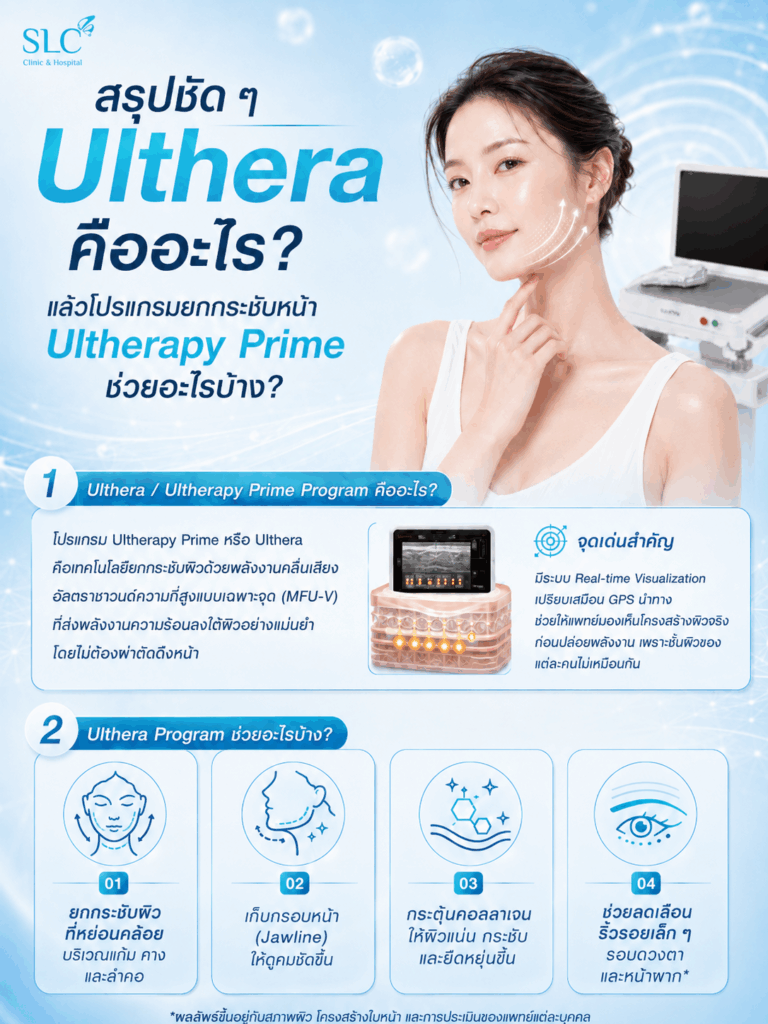
The standout feature that makes this technology a leader in the beauty industry is its real-time visualization screen, acting like a "GPS" to allow doctors to see the actual skin structure beneath the face before delivering energy. This is because everyone's skin layers are different; even in the same cheek area, one person may have a thicker layer of fat, while another may have thinner skin or deeper skin sagging.
So what exactly does the Ulthera program help with? The answer is, it doesn't just help with "face lifting" as many people understand. This innovation can help...
- Lifts and firms sagging skin on the cheeks, chin, and neck.
- To make the jawline appear sharper.
- Restore loose, sagging skin to a firm and elastic state by stimulating collagen production.
- Reduces the appearance of fine lines around the eyes or forehead. (Results may vary depending on skin condition, facial structure, and individual doctor's assessment.)
In-depth look at skin structure: Why is it important to know about the Collagen-Rich Layer?
Before we get to know the different types of Ulthera heads, how they work, and what they do, we need to understand that "collagen isn't concentrated in just one layer of skin," but is hidden at multiple depths. The main goal of Ulthera treatment is to deliver energy to the Collagen-Rich Layer (the layer with a high density of collagen), which is mainly divided into two layers:
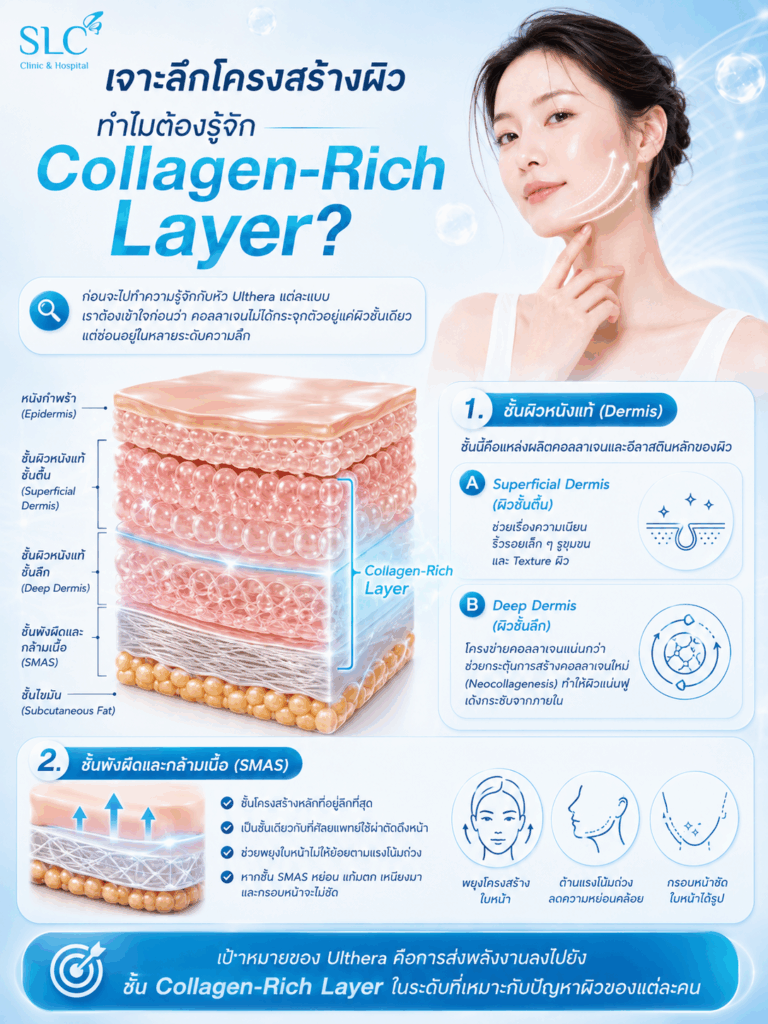
1. Dermis: This layer is the main source of collagen and elastin production in the skin. It can be easily subdivided into:
- Superficial Dermis (the superficial layer of skin): Helps with smoothness, fine lines, pores, and skin texture.
- Deep Dermis (Deep Skin Layer): The collagen network becomes tighter, and directing energy to this layer stimulates the production of new collagen (neocollagenesis), resulting in firmer, plumper, and more elastic skin from within.
2. The SMAS (Superficial Musculoaponeurotic System) layer: This is the deepest and most fundamental structural layer (the same layer surgeons use for facelifts). The collagen in this layer is very tough and strong, supporting the face and preventing sagging due to gravity. If the SMAS layer sags, the cheeks will start to droop, a double chin will appear, and the jawline will disappear immediately.
This is why Ulthera has multiple heads, such as the 4.5 mm head which is designed to work on deep structural layers, not just the surface skin.
In-depth look at the three types of Ulthera heads: what are the differences and why are there so many?
The Ulthera transducer in the Ultherapy Prime skin tightening program delivers energy to specific skin layers. It's designed to deliver energy at three depths: 1.5 mm, 3.0 mm, and 4.5 mm. These multiple depths are necessary because each skin layer requires different treatment. Some layers focus on smoothing fine wrinkles and pores, while deeper layers need to stimulate firmness and lift sagging facial contours.
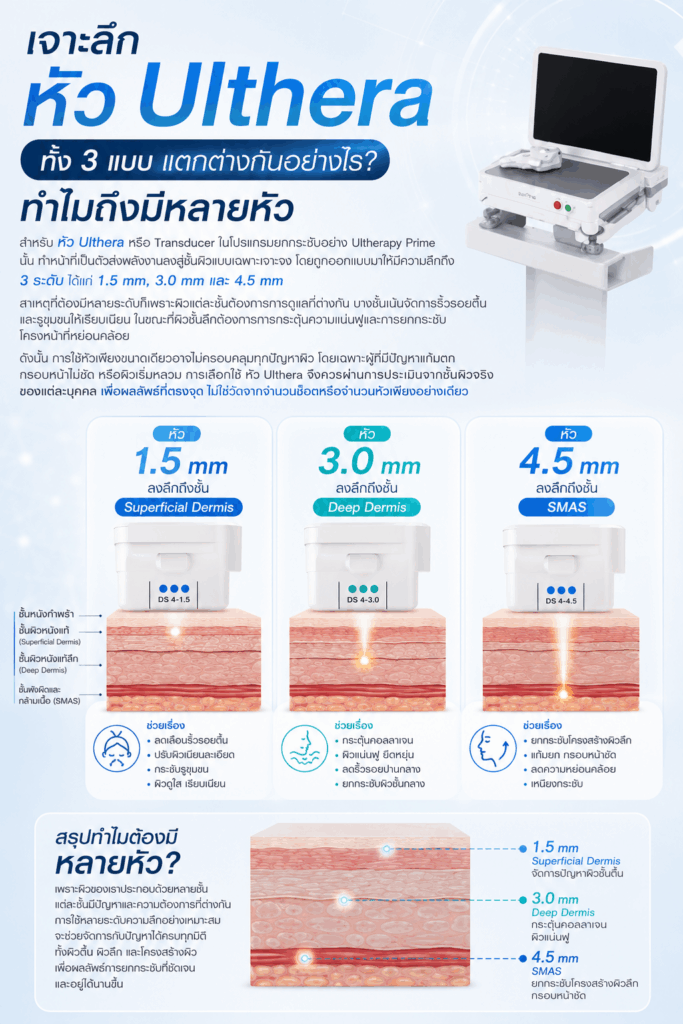
Therefore, using only one head size may not cover all skin problems, especially for those with sagging cheeks, undefined jawlines, or loose skin. The choice of Ulthera head should be assessed based on each individual's actual skin layers for targeted results, not just based on the number of shots or heads used.
Each head is not interchangeable because it targets a different layer of skin.
| Ulthera head | Target surface layer | To make it easier to understand. | Suitable for general problems. |
| 1.5 mm | Superficial Dermis | Keep the skin's surface smooth. | Fine lines, uneven skin texture, pores, skin texture. |
| 3.0 mm | Deep Dermis | Enhances skin firmness. | The skin is not firm, it's starting to sag, and the firmness and elasticity of the skin have decreased. |
| 4.5 mm | SMAS / Deep Fascia Layer | Provide a strong base for the surface. | Drooping cheeks, undefined jawline, double chin, and structurally sagging skin. |
Ulthera 4.5 mm head : Penetrates deep into the SMAS layer, like the "pillars of the face."
The Ulthera Program 4.5 mm head delivers energy deep into the SMAS layer, a crucial structural layer that supports the face. Think of it as the "main structure beneath the skin" that helps lift and tighten the facial contours.
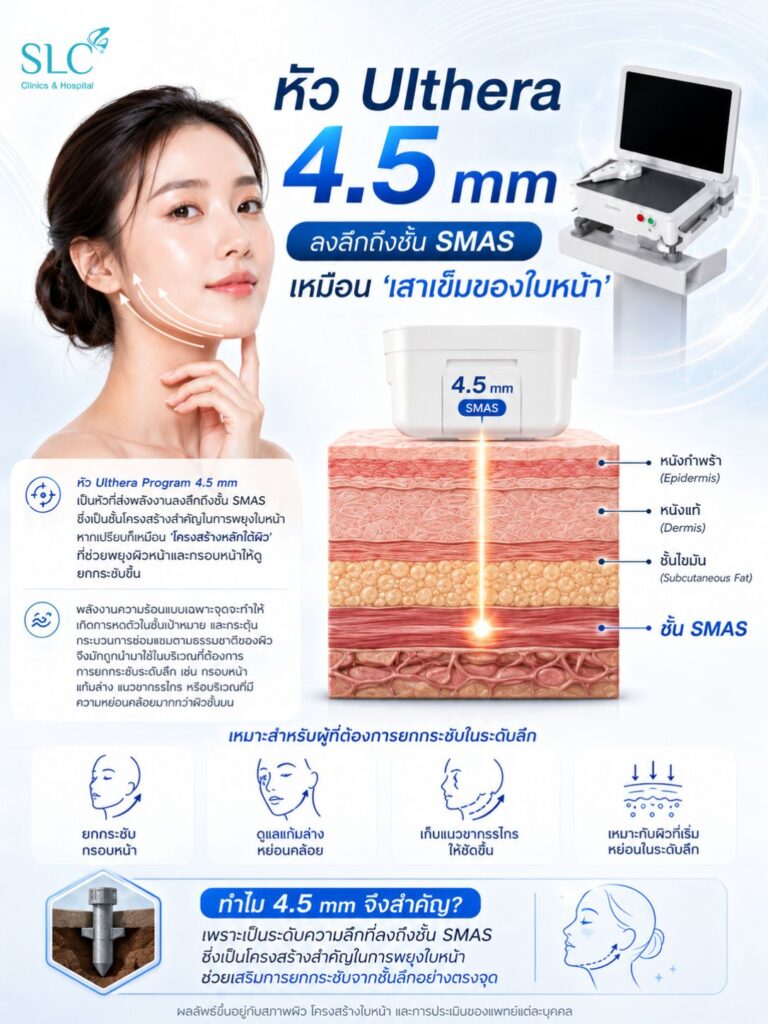
Targeted thermal energy causes contraction in the target layer, stimulating the skin's natural repair process. It is often used in areas requiring deep lifting, such as the jawline, lower cheeks, or areas with more sagging than the upper skin layers.
However, not all areas are suitable for deep penetration. If the skin is very thin or there is little tissue, the doctor may need to adjust the head, the energy level, or avoid certain areas as appropriate.
Ulthera 3.0 mm head : Enhances firmness and fullness in the deep dermis.
The Ulthera Program 3.0 mm head works in the deep dermis, the layer of skin that is related to firmness, elasticity, and overall skin quality from within.
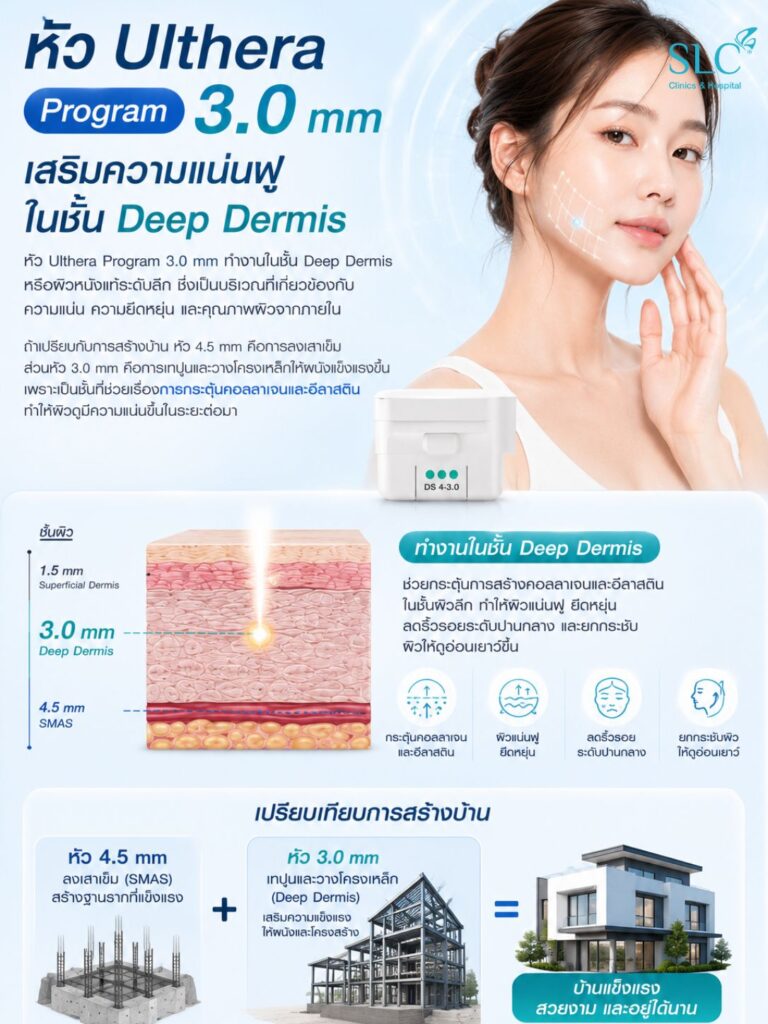
If we compare this to building a house, the 4.5 mm layer is like driving piles, while the 3.0 mm layer is like pouring concrete and laying steel reinforcement to strengthen the walls. This layer helps stimulate collagen and elastin production, resulting in firmer-looking skin in the long run.
This head is therefore often used in conjunction with other heads on the cheeks, under the chin, or areas where the skin is beginning to show signs of sagging, but where skin quality can still be improved.
Ulthera 1.5 mm head: For detailed treatment of the superficial skin layers.
The 1.5 mm Ulthera head works in the superficial dermis, or upper layer of the skin. It's suitable for treating shallow skin details such as fine wrinkles, skin smoothness, pores, or sagging skin at the surface level.
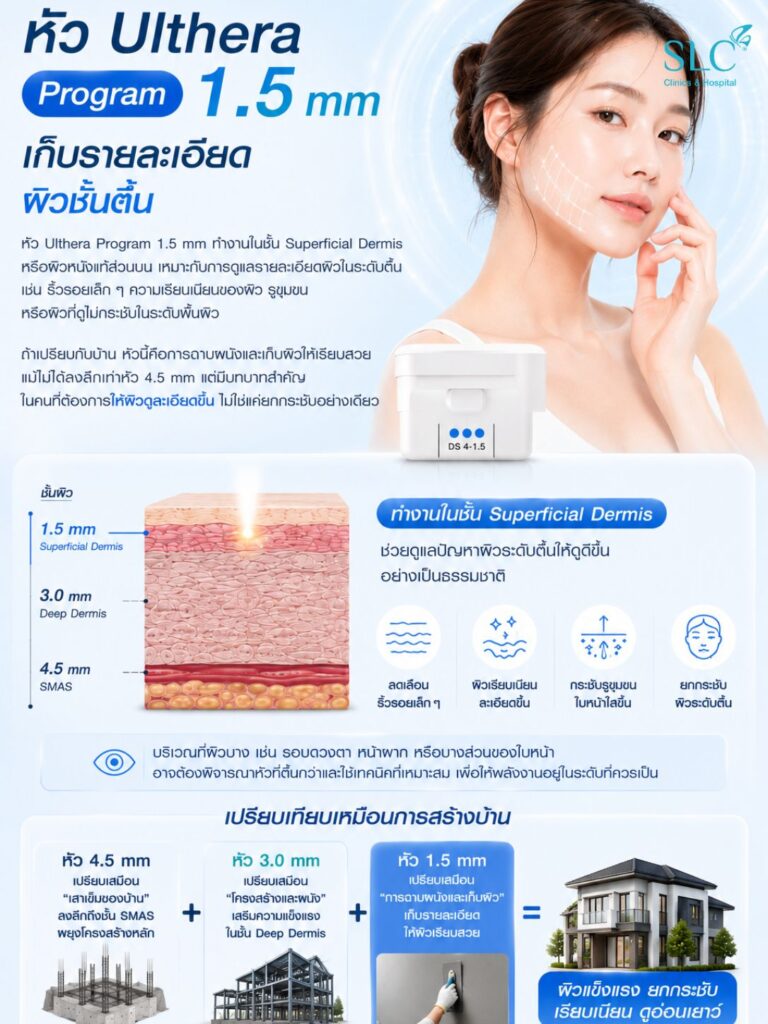
If we compare it to a house, this tip is like plastering the walls and smoothing the surface. Although it doesn't penetrate as deeply as a 4.5 mm tip, it plays an important role for those who want a more refined skin texture, not just a lifting effect.
For areas with thin skin, such as around the eyes, forehead, or certain parts of the face, a shallower applicator and appropriate technique may be needed to ensure the energy is at the correct level.
Why can't I use just one Ulthera head?
To answer directly, "A person's facial skin has multiple layers of problems." You might have sagging cheeks (SMAS layer – requiring 4.5 mm), while at the same time your skin is losing collagen and looking less firm (Dermis layer – requiring 3.0 mm), and you also have fine lines around your eyes (requiring 1.5 mm).
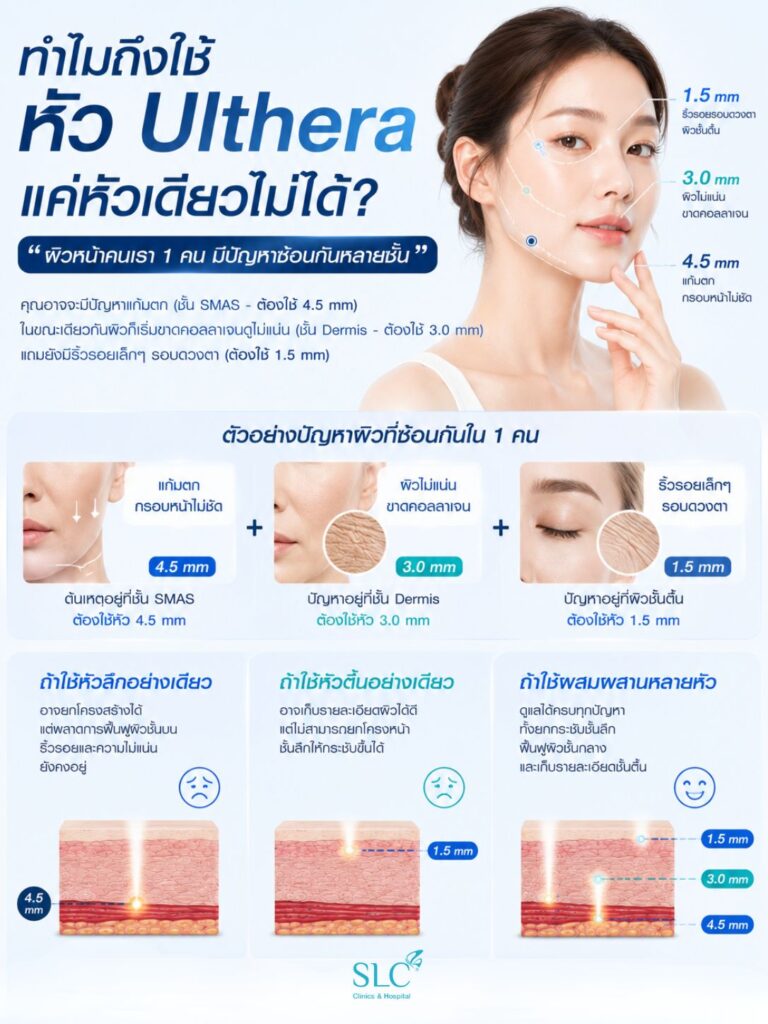
For example, people with sagging cheeks and an undefined jawline may need treatment targeting the SMAS layer to help with structural improvements. However, if the upper skin layer also has fine wrinkles or looseness, using only a deep-penetrating device may not fully address the superficial skin problems.
Conversely, using only a shallow head cannot lift the deeper layers of the face. On the other hand, using only a deep head may unfortunately miss out on collagen regeneration and treatment of the upper skin layers. Therefore, using a combination of heads based on the patient's actual anatomy provides the most complete full-face rejuvenation results.
Do we really need to use all of them?
Not necessarily. A successful Ulthera program isn't measured by "whether all three heads are used," but rather by "whether the right head is chosen for your specific problem and skin layer."
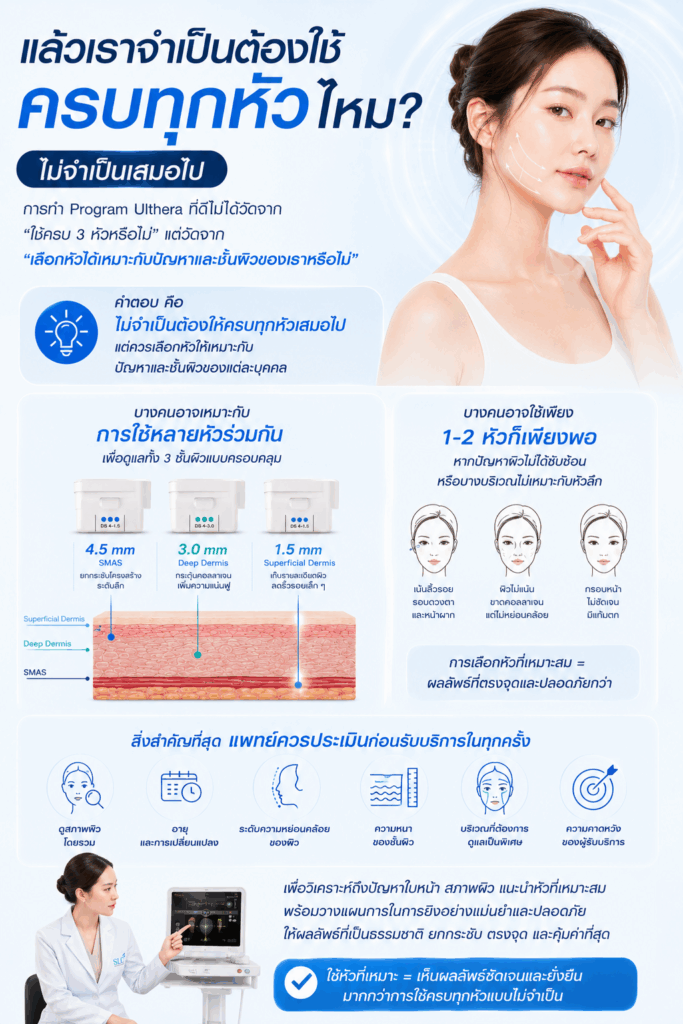
Some people may find it helpful to use multiple heads together to treat the SMAS, Deep Dermis, and Superficial Dermis layers, while others may only need 1-2 heads if their skin problems are not complex or if certain areas are not suitable for deep tissue treatments.
At SLC, doctors recommend that the most important thing is for a physician to conduct a thorough evaluation before every facelift procedure. This evaluation should consider skin condition, age, degree of sagging, skin thickness, areas requiring treatment, and the client's expectations in order to analyze the facial problems and skin condition, and plan the treatment schedule.
How does the Ultherapy Prime facial lifting program improve the precision of head selection?
For those looking for a facial lifting program, Ultherapy Prime is a highlight. Its key feature is an upgraded, larger, and 20% faster Real-time Visualization screen, allowing doctors to plan and perform skin tightening treatments as follows:
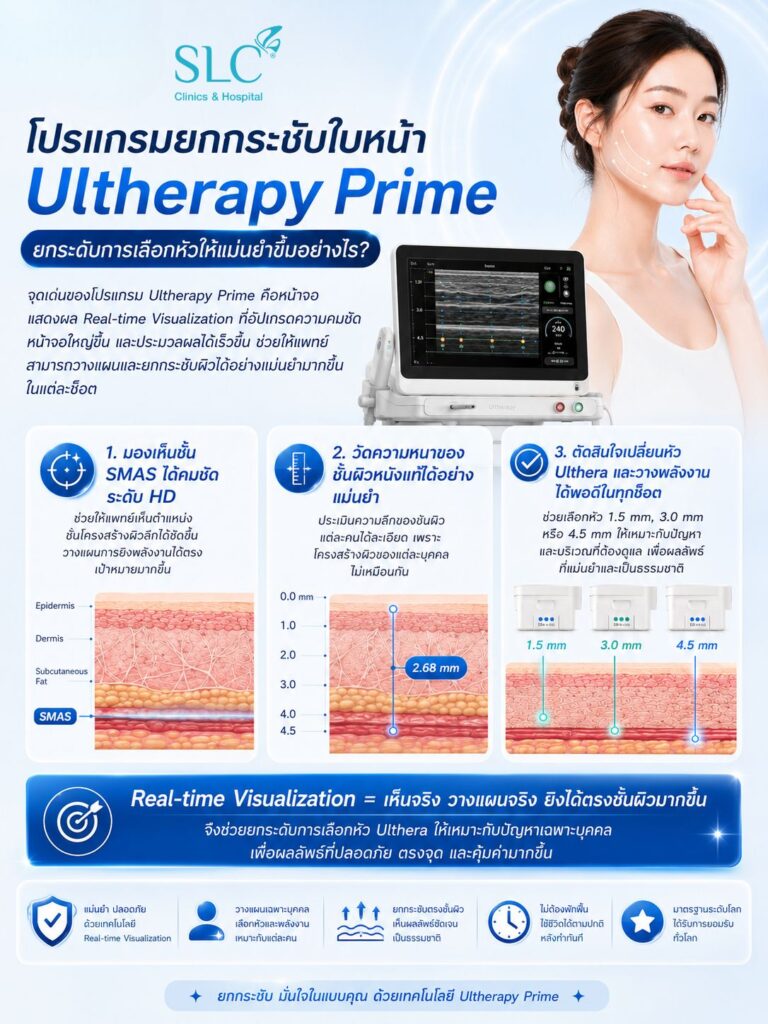
- The SMAS layer is visible in clear HD quality.
- Accurately measures the thickness of the dermis layer.
- Decided to change. Ulthera head And it distributes the energy just right in every shot.
Therefore, you can rest assured that the program design will be tailored to your facial condition at that very moment.
What questions should I ask before undergoing Ulthera treatment?
Before deciding on the Ulthera or Ulthera Prime program, you should ask clearly whether...
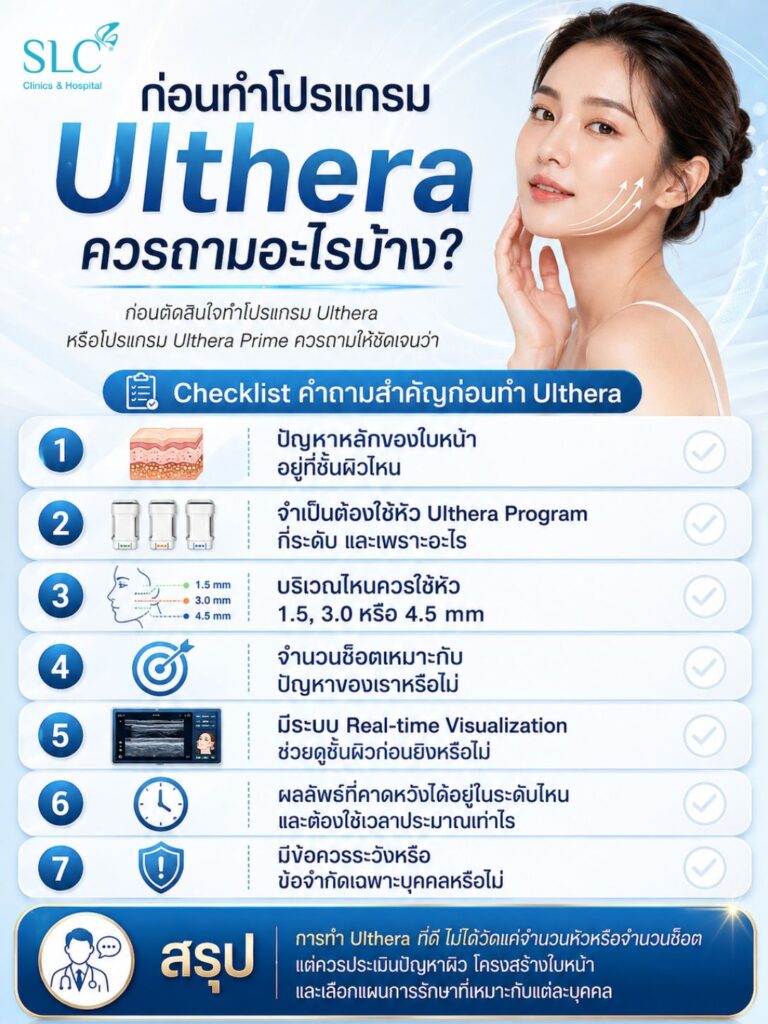
- Which skin layer is the main source of the facial problem?
- How many levels of the Ulthera Program are needed, and why?
- For which areas should a 1.5, 3.0, or 4.5 mm tip be used?
- Is the number of shots appropriate for our problem?
- Does it have a real-time visualization system to help view the skin layers before treatment?
- What are the expected results, and approximately how long will it take?
- Are there any specific precautions or limitations for individuals?
These questions will help you choose a program not based solely on price, but on an understanding of your skin type and what truly suits you.
In summary, the Ulthera head is not selected based solely on depth, but also on our anatomy. The physician must make a clear assessment.
Each Ulthera head size is designed to work on different skin layers. The 4.5 mm head focuses on the SMAS layer for structural lifting and tightening. The 3.0 mm head focuses on the deep dermis for firmness and collagen stimulation. The 1.5 mm head focuses on the superficial skin layers, fine wrinkles, and skin texture.
Therefore, using only one head may not solve all problems, especially for those with sagging, loose skin, and wrinkles in the upper skin layer. However, this doesn't mean everyone needs to use all the heads. The most important thing is to assess the actual skin layers and design a program tailored to each individual.
If you are interested in the Ulthera or Ulthera Prime program and want to know which Ulthera program head is right for you, you can have an evaluation and consultation with our medical team at SLC Clinic to plan a skin care treatment that is appropriate for your skin condition and goals.
Book an appointment for consultation and services at https://booking.slc-group.com
For more information
Call Center: +66 2 714 9555
Whatsapp: + 66 96 116 0806
Facebook: SLCclinic
Skype: SLCclinic
LINE : @SLChospital
*Note: This article is for consumer education purposes only and is not an advertisement for a medical device. Individual results vary. Consult a doctor before considering any procedure.
Consult a doctor for free before making a decision.
The doctor assesses the skin condition, the areas requiring treatment, and creates a personalized treatment plan for each individual.